Spring in Palestine
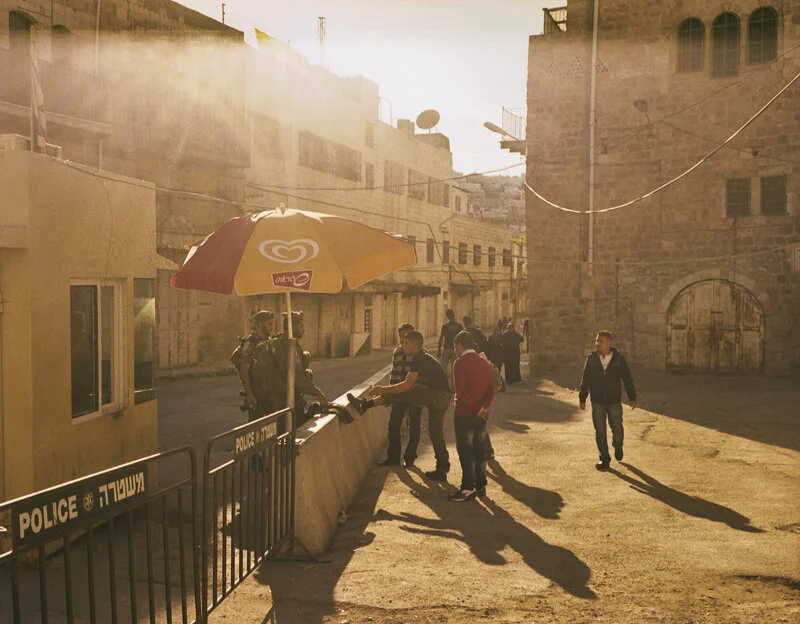
As the Arab Spring rolled through the region in 2011, I wrote a piece for GQ (Germany) about the (lack of a) Palestinian revolutionary movement. Below is an excerpt in English and the full piece in PDF form.
Fadi Quran’s first memory of the Israeli occupation is the Second Intifada. Ramallah, the de-facto capital of the West Bank and Quran’s home town, was under military curfew for weeks on end. Unable to buy necessary food staples because of the constant presence of Israeli tanks and soldiers, Quran’s family was literally starving. Driven by childhood immaturity and anger, Quran would collect trash in large boxes and place the boxes at the entrance to his neighbourhood. Suspecting the mysterious packages were bombs, the Israeli military would send in advanced robots to inspect the bags of trash. The operation would take hours, giving Quran’s neighbourhood valuable time to run out and resupply groceries before the tanks and soldiers returned and the curfew resumed.
There are no more curfews in Ramallah but for Quran the occupation is still a facet of his daily life. He relayed his childhood experience as we drove to the Qalandia checkpoint, the unofficial Israeli border between Ramallah and Jerusalem, which he is barred from crossing. For many Palestinians, Qalandia, with its imposing guard towers and military jeeps, is the physical embodiment of Israel’s control over their lives. Last May, 23-year-old Quran, along with other young political activists staged a massive demonstration at Qalandia. The goal of the demonstration was to enter Jerusalem but they were stopped by a hail of Israeli bullets and tear gas canisters.
The blue green mountains of the West Bank, the physical landscape of the Bible, have slowly transformed since Israel’s conquest of the territories in 1967 from idyllic rolling mountains into a series of disjointed hilltop Israeli settlements, settler only highways and Israeli checkpoints. The contrast between Palestinian villages and Israeli settlements is stark. The villages lazily fit into the landscape, often using mountaintops as protection from the harsh winds which rattle the area year round. Israeli settlements, in an audacious demonstration of their presence, sit squarely on mountains tops. Connecting these far flung villages and settlements are a system of roads and checkpoints which are constantly, relentlessly monitored by Israeli military jeeps.
Twenty four year old Diana Alzeer was almost born at an Israeli checkpoint. During the First Intifada, Alzeer’s village of Salafit, which sits quietly below Ariel, one of the largest settlements in the West Bank, was under constant curfew. As she went into labour, Alzeer’s mother was stopped at the entrance to the village by soldiers. While in labour, she was forced to sneak around the checkpoint, running through a ravine to a main road, until she reached a family friend who drove her to a local hospital.
Born during the First Intifada and raised in the Second, Alzeer has been living in Ramallah for the past four since completing a degree in journalism at Bir Zeit University. She is intimidating despite her petite appearance . When you begin talking about the state of Palestinian activism, her small frame barely conceals her fiery rhetoric and a litany of grievances she has with the current politics in the West Bank.
Alzeer and Quran are emblematic of the next wave of Palestinian activism in the Occupied Territories; young, energetic and disconnected from Palestinian party politics and inspired by the Arab Spring. Hidden from the news cycle of endless peace negotiations and fears of impeding violence in the region, non-aligned political activists are perfecting forms of civil disobedience, which they believe will form the backbone of the next chapter in the conflict between Israel and the Palestinians. Rural villages dotting the rugged landscape of the West Bank, which have been directly affected by Israel’s controversial Separation Barrier, are a rallying point for a nascent popular resistance movement in the Occupied Territories.
In 2003 at the height of the Second Intifada, when bombs were exploding in Tel Aviv cafes and the Israeli military was imposing curfews throughout the West Bank, an unassuming Palestinian village named Budrus began a non- violent campaign against the Separation Barrier’s construction on its farmland. According to the Israeli government, the barrier needed to be placed inside of Budrus to ensure security of nearby settlements. After two years of almost daily non-violent demonstrations, some of which saw Palestinian women standing directly in front of working bulldozers, the Israeli military made an unprecedented decision to change the route of the barrier. Ninety- five percent of the farmland in Budrus, which would have been swallowed by the barrier, was saved through noncompliance and popular resistance. The Popular Struggle - the umbrella term for current non-violent resistance movement in the West Bank - had its first victory.
Ayed Morrar is the man who led Budrus to its historic non-violent victory. A lifelong member of the Fatah party until he recently quit over recent attempts by the Palestinian Authority to take control of the Popular Struggle movement, Morrar was active as an organizer during the First Intifada in the late 1980’s. The ‘Intifada of stones’, as many Palestinians call it to differentiate from the armed struggle of the Second Intifada, was marked by mass protests, civil disobedience and boycotts of Israeli goods in the Occupied Territories. It was a far cry from the suicide bombers and the violence which typified the Second Intifada.
For his role as a community organizer and a member of the outlawed Palestine Liberation Organization (PLO), Morrar spent seven years in Israeli jails. It was during his time in jail that Morrar’s outlook on armed resistance transformed. While armed resistance remained a legitimate form of resistance according to international law, Morrar realized that non-violent resistance was the better vehicle to achieve Palestinian independence because it demonstrated the Palestinian cause as oppressed people who needed international support. The power imbalance and the occupation are displayed when Palestinians do not use violence.
Morrar is an unusually modest man given his reverence among Palestinian activists stemming from his pioneering role as a community organizer in the West Bank. His family home, which sits overlooking a swallow ravine filled with olive trees, is carefully adorned in typical Palestinian style; three floors with a lavish greeting room reserved for guests and nothing else. Unlike most Palestinian homes, Morrar’s greeting room includes awards from Amnesty International and Human Rights Watch for his non-violent leadership.
“After Budrus, many villages throughout the West Bank adopted our model of non-violence,” Morrar noted after offering small cups of sweet Arabic coffee. “People at the time understood that our issue is about freedom and not about economic or establishment issues. When the First Intifada took place in 1987, our economic, social and political situation was better than now. During the First Intifada and in Budrus in 2003, people were not looking for more money or to build a state. The main issue was, and is, freedom.”
The model of non-violent resistance which Morrar championed in Budrus is still present in the West Bank. Every Friday afternoon, after the midday Islamic prayer, a diverse array of Palestinian villagers, international supporters and Israeli peace activists gather in windswept village squares across the West Bank before confronting the Israeli military. Each village has a different story but the issue is always the same; the slow confiscation of land by Israeli settlement infrastructure.
One wet and windy Friday, in the village of Quroyt, just south of the ancient city of Nablus, Diana Alzeer joined other activists in protesting the expansion of the nearby Israeli settlement of Shiloh into the village’s farmland. The demonstration began with spirited calls for Palestinian unity but quickly took a confrontational tone when the activists were face to face with the soldiers.
The tenacity of Alzeer during the demonstration is staggering. She leads chants, her voice cracking as she demands an end to the Israeli occupation. One villager offers her a bullhorn which she stubbornly rejects, preferring to continue with a strained voice.
After nearly a decade the demonstrations have a relatively choreographed sequence; peaceful protests devolve into crowd control and stone throwing. Activists march towards contested lands and are stopped by a blockade of Israeli jeeps and soldiers, ready to break up what they consider to be illegal riots. According to the Israeli military, all protests must be coordinated with the military governor, who holds the sovereign authority to grant demonstration permits. Since 1967, few permits have been issued for any type of Palestinian demonstration.
Alzeer is everywhere. She runs to the front line and speaks in English with soldiers about her right as a Palestinian to be on her land before renewing chants and leading the 200 protesters forward towards the contested land recently swallowed by the settlement. She barely has enough time to collect her thoughts and tweet live updates to her thousands of followers on the popular social networking platform Twitter.
Out of nowhere, the first volleys of tear gas rain down on the protesters. A settler security guard arrives and fires live rounds into the air, sending the protesters into a panic. Some Palestinian youth take advantage of the chaos and start throwing rocks at the soldiers. Alzeer quickly runs to the back of the demonstration bemoaning its sudden turn to violence. Within an hour, the army and the rock throwing protesters have exhausted their desire to continue with the exchanges. The demonstration is declared over by villagers. But the day is not finished for Alzeer and her fellow activists from Ramallah. Before returning home, they decide to stop in the tiny hamlet of Nabi Saleh, just west of Ramallah, where a similar demonstration has entered its fifth hour.
The group of tired activists survey the scene in Nabi Saleh; the non-violent protest has already been broken up and Palestinian youth are now engaged in a game of tit-for-tat with Israeli soldiers. Occasionally clouds of tear gas envelop the area eliciting coughs and gasps of air.
Alzeer tweets the number of arrested and injured before commenting that the Israeli military spokesperson is calling the protest a violent riot on Twitter. They are claiming that we are violent rioters, she announces to her fellow activists, but they are not talking about how the soldiers started this cycle of violence by firing rubber bullets inside houses throughout the village.
Standing in front of the Separation Barrier meters away from the Qalandia checkpoint, Fadi Quran describes the primary challenges that his movement faces in Palestine. “The question is how we are going to speak to the core social and economic needs of average Palestinians,” he notes looking across the wall at the now defunct Palestinian airport which sits on the other side. “We need to tie the social and economic to the political reality on the ground. This is a challenge but not a challenge for people in villages like Nabi Saleh, who have had their land taken by settlements.” He continued, “They see it; the link is obvious between the settlement taking their land, and their poverty. But in places like Ramallah and a lot of cities in the West Bank, it is not obvious anymore.”
The March 15th movement is a loose collective of urban activists who share Quran’s vision of transforming the Palestinian struggle. The movement emerged last year in Gaza and quickly spread to the West Bank as a Palestinian response to the Egyptian revolution. Rebuilding Palestinian national identity, which has been badly damaged by the last six years of internal division between Fatah and Hamas, has been the driving focus since its inception. Activists living in major cities who regularly travel to village protests decided to bring the reality of the occupation into the heart of Ramallah, a city often compared to Tel Aviv for its disconnected lifestyle. During one of their first protests in solidarity with the Egyptian people, plain clothes Palestinian Authority police officers arrested and beat a number of activists.
Despite its portrayal in the West, the Palestinian Authority (PA) is not well liked in the West Bank. Set up in the 1990s as part of the Oslo peace process, the PA was designed as an interim governing authority for Palestinians. Most Palestinians believe that the current Fatah dominated PA is corrupt and ineffective. Fadi Quran claims that the March 15th movement does not target the Palestinian Authority but aims to develop a new way of fighting the occupation, through noncompliance, mass protest and non-violence. “At the moment, in Palestinian history and the history of the region, popular resistance and civil disobedience are the necessary tactics that should be used and at this moment in time they are the only tactics that we have to achieve freedom, justice and peace for all.”
Quran and Alzeer do not confine their activism simply to protesting and organizing. Quran recently returned to Ramallah after completing a degree in engineering and international relations at Stanford University. He is working on a start-up green energy company which will bring wind electricity to Palestine, thus lowering Palestinian dependence on Israeli energy, which is provided at inflated prices to the residents of the West Bank. Alzeer is similarly involved in an organization she believes to be helping the Palestinian people. She is the chief media officer of the Central Elections Committee- the independent observer of Palestinian elections in the West Bank and Gaza. For the new generation of Palestinian activists, activism can’t be divorced from daily life.
Non-violence as a tactic is a striking component of the March 15th platform. Western observers have long wondered why Palestinians have not adopted forms of non-violent resistance on a larger scale. The commonly held position states that if Palestinians adopted such tactics, then the West would quickly and wholeheartedly rally behind the Palestinian struggle. According to activists, non-violence has been employed for years but is often overshadowed by attacks on Israeli civilians by radical political factions. “As Palestinians, we tried armed resistance during the Second Intifada, apart from the fact that I do not agree with it in any way, it only got us backwards,” Diana Alzeer noted in her modest Ramallah apartment, the evening before a demonstration. “We did not move forward.”
Ultimately, Fadi Quran argues, the role of activists must be to make Israel’s occupation as difficult as possible to manage, using every non-violent tactic at their disposal. In a conflict where one side is at a great disadvantage in regard to power relations, symbolic acts of non-compliance are perhaps the only way of inflicting significant damage. “The only thing that really puts pressure on the Israelis throughout history in terms of their relationship with Palestinians, has been acts of civil disobedience like those of the First Intifada. It forced the Israeli government to give concessions to the Palestinians.”
Informed by the history of the Palestinian struggle, Alzeer and other young activists are challenging the status quo of the Israeli-Palestinian conflict at a time when the world is counting on the next chapter of the Arab Spring to play out in Palestine. Last May, thousands of Palestinian refugees in Lebanon and Syria and hundreds of March 15th activists in the West Bank gathered at Israeli borders and checkpoints to mark the anniversary of the Nakba- the Arabic word for Catastrophe, which Palestinians use to commemorate the creation of the state of Israel. Since the Second Intifada, Israel has created a myriad of borders and checkpoints to isolate and subdue Palestinians for security reasons. The idea of the March 15th activists was simple; hold symbolic mass protests at these border crossings and checkpoints to remind the Israelis of their presence.
Many people in the West Bank, not just activists, speak of the First Intifada as a crowning achievement of unarmed Palestinian resistance. The problems facing Palestinians currently, they argue, often vociferously, are numerous barriers designed to prevent another mass unarmed resistance. The Israeli army, Israeli settlers, internal division between Fatah and Hamas, and the Palestinian Authority’s perceived allegiance to Israeli interests are most often cited as preventing an honest manifestation of Palestinian will on the streets.
The influx of international donor aid in the Occupied Palestinian Territories after the signing of the Oslo peace accords in 1994 is frequently cited as a factor in preventing open rebellion. The donor economy has created a generation of Palestinians unwilling to risk their relatively comfortable lives in the status quo which currently dominates the conflict. Their fears are not entirely irrational. After the United Nations statehood bid in September, USAID, the primary vehicle of American aid to the West Bank announced that it would cut half of its aid. The only programs that USAID now funds are connected to the Palestinian Authority security establishment.
Recently, the Israeli high court upheld a law barring West Bank Palestinians from marrying Palestinians with Israeli citizenship which live within the green line separating Israel from the West Bank. While walking along the Separation Barrier near Qalandia, Fadi Quran noted that the control which he faces every day has now been extended to love. If he were to meet a Palestinian from East Jerusalem, a system of laws and an eight meter high wall would end their relationship before it started. With nothing left to lose, Palestinian activists are coalescing around non-violence as a way of highlighting how the occupation has invaded every aspect of their lives.
In 1995, the late Palestinian scholar Edward Said wrote that the signing of the Oslo peace accords by Palestinian leader Yasir Arafat amounted to nothing more than surrender. Young Palestinians are fed up with surrender and with violent resistance. They are inspired by their own Palestinian history and energized by the revolutionary climate in the Middle East. Although peace is clearly desired among activists, their immediate concern is their lack of human rights. A simple protest against the slow confiscation of land by Israeli settlements is a last ditch attempt to demonstrate that there are some in Palestine who reject violence in order to highlight their dignity under fire.
The power of civil society to affect change in the Middle East is the lasting contribution of the Arab Spring. But for Palestinians, civil society has been affecting change since the beginning of their struggle. The problem, as activists understand it, is the corrosive influence of party politics, the reliance on armed resistance against a formidable military, and division. The last twenty years of endless peace negotiations and sporadic cycles of violence have been the worst for Palestinians in terms of their abject loss of their rights. It is only a matter of time before the majority again takes the lead of the activists.
“We taught everybody in the Middle East how popular resistance works,” Ayed Morrar said. “In the First Intifada, before Facebook and Twitter, while the Arab people were in a deep sleep, we taught them how to resist. Now we see real examples of people achieving their freedom in front of us and the price of our freedom is not more than their price. We are ready to pay this price.”