Trouble in the Promised Land
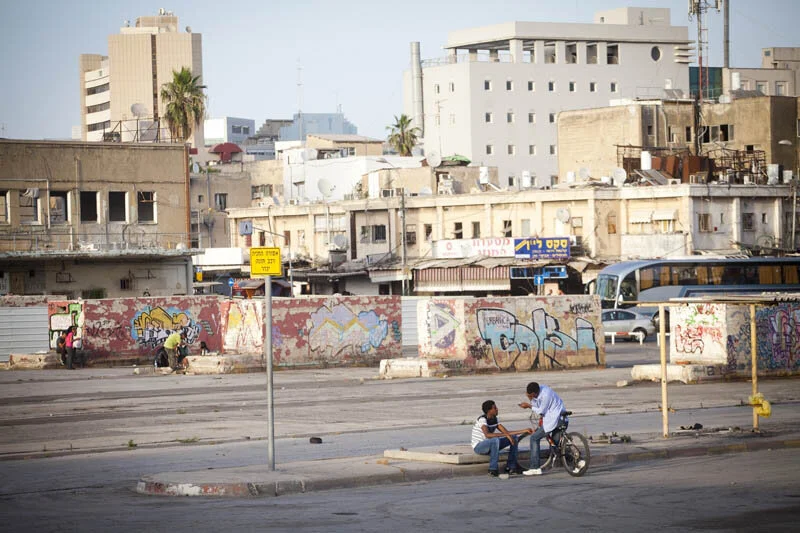
As many as 60,000 African migrants, many from Eritrea, live and work in Israel, often in exploitative circumstances and increasingly under threat of violence from Israelis. For Cityscapes, I visited South Tel Aviv, a key battleground. Below is an excerpt and a link to the full magazine piece in PDF form.
Neatly tucked inside the crooked, cobbled alleyways of Jaffa’s old city sits an idyllic café. Popular among locals, Café Napoleon’s soft music and Middle Eastern food provides ideal respite from the heat and commotion of Israel’s unofficial capital city. An ancient port city, which once served as Palestine’s commercial centre, Jaffa is now part of the Tel Aviv municipality and at the very heart of the city’s aggressive gentrification wave. Restaurants and cafés are popping up at a dizzying rate, bringing with them a fleet of migrant workers. In a dingy closet, at the very back of Café Napoleon, an Eritrean man named Kesede quietly cleans dishes and sometimes prepares food. With a slight build and quick smile, Kesede greets customers as if they were old friends popping by for coffee at his home.
During the day Kesede works in another café, in the upmarket Basel neighbourhood of north Tel Aviv, where one cup of coffee costs about $5. After his day shift in the north, he returns to the south and continues to work into the early hours of the morning. The leafy streets of north Tel Aviv, filled with well-dressed Tel Avivians, are a far cry from the area of town Kesede calls home. At the end of each workday Kesede cycles ten minutes to a cramped flat just steps away from Tel Aviv’s derelict central bus station. This neglected area of town, known by many as “south Tel Aviv”, is a dystopian world of drug dealers, sex workers, and neon lights. It is also the unofficial capital of thousands of African refugees, asylum seekers and East Asian migrants living in Israel.
Kesede’s flat is at the top floor of a decrepit whitewashed building. The fluorescent lights illuminating the stairwell, which give the place the feeling of an Egyptian interrogation centre. Inside the flat, eight people share two cramped rooms. A simple stove and television are the only furnishings other than a series of mattresses that occupy almost every available inch of floorspace. The place is littered with Nokia cellphone chargers. Despite resembling a tenement building in New York’s Lower East side, the monthly rental is on par with the most expensive flats in central Tel Aviv and totals nearly $2,250.
Kesede and his flatmates all fled the dictatorship of Isaias Afewerki in Eritrea. If they return, they face certain imprisonment and possibly death as unofficially leaving the country is considered an act of treason.
“I left my home for a better life,” Kesede tells me as he closes up at Café Napoleon one evening. It is one in the morning and a strong breeze from the Mediterranean engulfs the café. Kesede has been working since six the previous morning. “But now I have no place to go. I am trying to get my wife to Israel. We can start a new life, but the costs and the risks are so high.”